

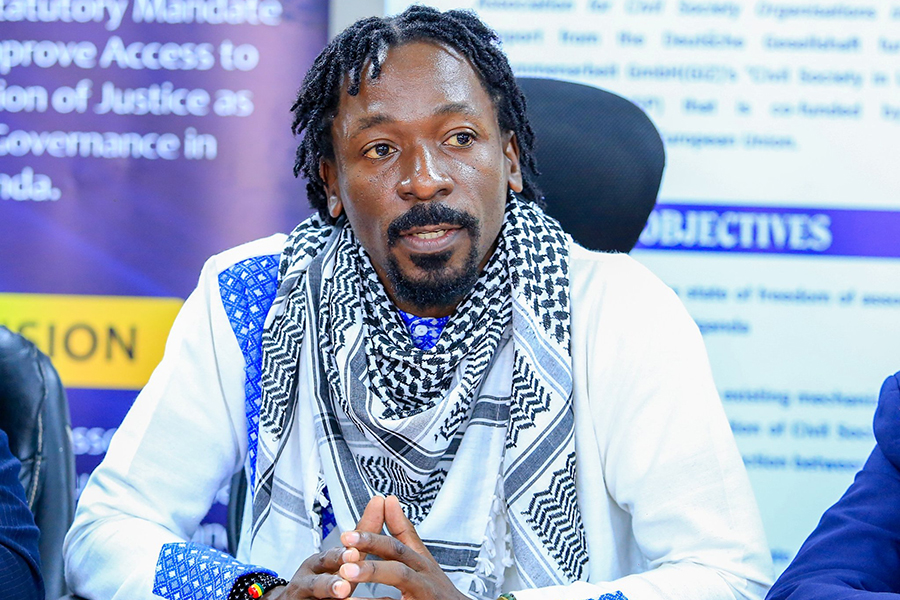
The Uganda Law Society (ULS) has accused the state of entrenching what it describes as a “two-tier justice system,” following President Museveni’s remarks on the withdrawal of corruption charges against several Members of Parliament.
In a statement dated April 10, 2026 and signed by ULS President Isaac Ssemakadde, the legal body said recent developments “lay bare a deeply troubling reality” in Uganda’s justice system, arguing that it has “deteriorated into a tool of selective political persecution.”
The controversy stems from comments made by President Museveni during the National Resistance Movement (NRM) leaders’ retreat in Kyankwanzi, where he stated that some MPs previously charged with corruption had been forgiven after repentance.
“They were arrested and later repented. Once you repent, there is forgiveness,” Museveni said, adding that the lawmakers had “asked for pardon, and indeed they were pardoned.”
The ULS said the President’s statement “leaves no room for doubt” regarding the withdrawal of corruption cases involving Yusuf Mutembuli (Bunyole East), Paul Akamba (Busiki County), Cissy Namujju (Lwengo District Woman MP), and Amos Lugolobi, the State Minister for Finance.
The Society referenced nolle prosequi entries filed on January 6, 2026 at the Anti-Corruption Court and another on November 11, 2025, noting that these withdrawals had raised unanswered questions.
It revealed that it had written to the Director of Public Prosecutions, Lino Anguzu, on January 7, 2026 seeking clarification on the legal basis for the withdrawals, but said “no response has been forthcoming.”
“The President’s candid admission now supplies the answer the public was never meant to receive,” the statement read, arguing that the developments confirm concerns about executive influence over prosecutorial decisions.
The Law Society said the situation reflects a broader pattern of selective justice, describing it as “not new,” and cited the October 2022 withdrawal of corruption charges against businessman Hassan Basajjabalaba and his brother Muzamiru Basajjabalaba as further evidence.
It warned that “Uganda’s criminal justice system has deteriorated into a tool of selective political persecution,” alleging that it operates a “police-to-prison pipeline” targeting the poor and opposition figures while shielding politically connected individuals.
The ULS also raised concern over what it described as thousands of opposition supporters who “remain in detention on charges that bear the hallmarks of political persecution,” arguing that they receive no comparable leniency.
Criticising the judiciary, the Society said courts have “routinely accepted withdrawals of criminal charges without scrutiny,” adding that prosecutorial independence “is not a cloak of immunity.”
It cited the case of Mohit v Director of Public Prosecutions of Mauritius (2006) UKPC 20, noting that it affirms that the Director of Public Prosecutions must exercise power “lawfully, rationally, and properly,” and remains subject to judicial review.
The ULS further argued that Uganda’s constitutional framework is structurally flawed, stating that placing the DPP within the Executive makes independence “only on paper when presidential direction can so easily override prosecutorial decisions.”
“Accountability mechanisms now function on two distinct tracks: one that shields the rich and powerful, and another that crushes ordinary citizens,” the statement said.
The Society also cited estimates attributed to the Inspectorate of Government that Uganda loses at least Shs 10 trillion annually to corruption, warning that selective prosecution worsens underdevelopment and erodes public trust.
Calling for reforms, the ULS said “selective prosecution will end only when the Constitution guarantees structural independence for the DPP,” proposing that the appointment, supervision, and removal of the office be placed under an independent parliamentary committee.
“No lesser reform can restore prosecutorial integrity or public trust,” the statement added.
The Uganda Law Society concluded by condemning “in the strongest terms” what it described as the entrenchment of a two-tier justice system, insisting that “equal justice under law is not a slogan; it is a high constitutional principle enshrined in Article 21.”
